
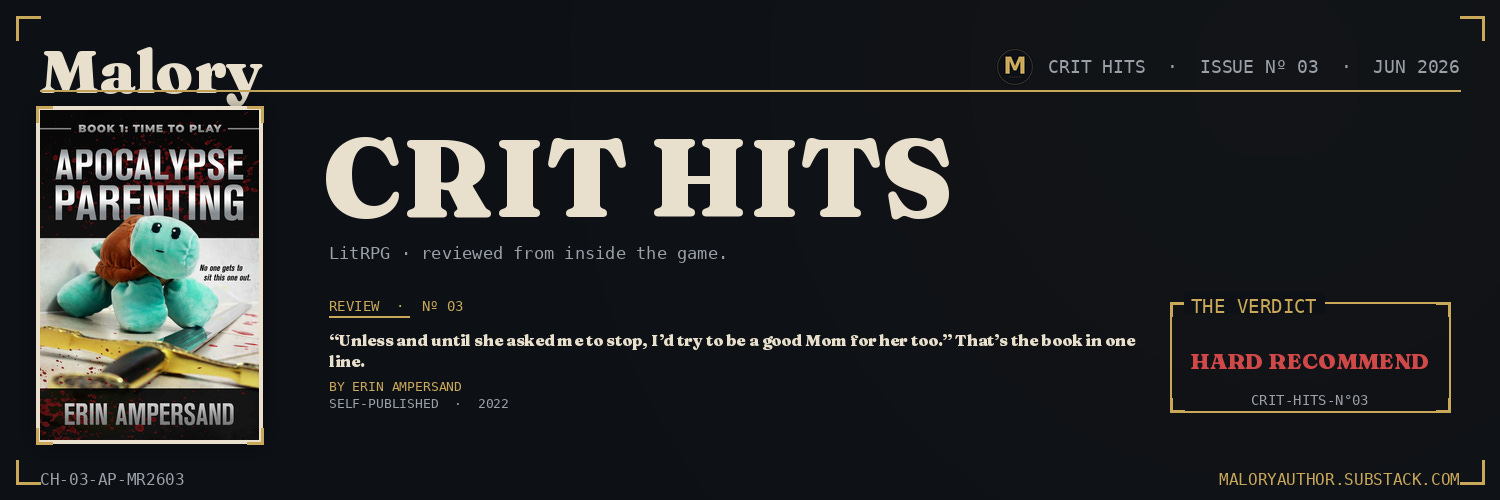
Apocalypse Parenting: a system-apocalypse novel where the most consequential ability is a three-year-old’s stuffed turtle
Crit Hits — Issue Nº 03. LitRPG, reviewed from inside the game.

When the planet of Apocalypse Parenting gets selected for the universe’s deadliest reality TV show, the first thing that happens is that the power goes out. At which point the first thing our protagonist thinks is that this is going to ruin her plan to dry Gavin’s gi pants in time for aikido tonight.
Yeah, that’s what kind of book this is.
This is the third of my reviews of LitRPG Book Ones, and the first two were the obvious picks (as several of you pointed out!). My first was about Primal Hunter, whose Jake Thayne is an introvert who barely speaks, while the second was He Who Fights with Monsters, whose MC can’t shut up.
Both of those focus on men in their late twenties who confront their apocalypses alone.
So, rather than publish what I planned this week (Defiance of the Fall postponed for a week or two), the focus of this book is one about a mother of three instead.
Meghan Moretti lives in Huntsville, Alabama, with her husband Vincenzo (he’s away on a business trip when the system arrives, and will be away for the rest of Book One) and her three kids, Micah (9), Gavin (6) and Cassie (3). Oh, and, as of about page eight, an alien game-show interface helpfully suggesting starting abilities for the species-wide death tournament kicking off on her front lawn.
The aliens call the game the Maffiyir. They televise it, and their contestants are… us.
Cassie chooses her first ability, because she’s three, to be all about her stuffed turtle, Pointy. This means Pointy now talks, and is issued with an American cultural pack, all of Earth’s languages, and roughly 100,000 hours of broadcast footage from the previous Maffiyir. That makes her, in her own words, “a very limited information and communication artificial intelligence.” And she loves Cassie.
Pointy is also the book’s comic engine, and how Ampersand runs it is worth noticing. Most of the jokes come from the gap between Meghan’s exhausted narration and a turtle reading an alien death-game off an American cultural pack she only half understands. For example, Pointy confidentally reassures everyone that reality TV doesn’t actually kill its contestants, then stands corrected once she’s reviewed her own footage. The characters seriously funny without ever being built as comic relief, which is a much harder trick to pull off than it looks.
The first time Meghan loses an argument with Cassie, it’s about chalk. Meghan has set up a campfire in the garage to cook chicken nuggets, because the electricity is now permanently gone and the chest freezer is on a one-week timer. She wants Cassie in a contained area where she can keep an eye on her, so she draws a chalk box on the floor. Cassie objects, because the box is blue and Cassie wants a green box. Meghan, who has been awake too long and has run out of arguments she’s willing to have today, draws a second box, in green. Cassie sits down in it smugly.
And that’s the second key moment when the reader knows what kind of book this is too.
Because the book’s central inversion is that Meghan does not get the solitary-chosen-one starter kit.
Her first two abilities are Draw Attention (which forces enemies to look at her for up to a minute) and Assisted Strike (a modest aim-assist), and after three weeks of hard work she’s still climbing the gentle slope toward something like actual competence. On the other hand, her nine-year-old, who has selected Conjure Flame and then Freeze, hits a 200% bonus on both inside a week and starts being able to read temperatures off objects like a kitchen thermometer.
The mechanics of how powers in this universe work deserve at least a paragraph, because it’s really well thought through. Ampersand’s system isn’t stat-based and characters get to select abilities. How these abilities subsequenly improve depends on how well those chosen powers synergise with each other. And the synergy logic here is properly worked out, not hand-waved through on a nod and a wink.
Micah’s flame-plus-freeze pair gets the 200% boost because both abilities operate on the same underlying principle of adding or subtracting energy from molecules, not simply because they’re both elemental. There’s a scene where Meghan reasons this out in a neighbour’s kitchen, while her son cheerfully refreezes the family’s thawing chicken, and the prose just stops for half a page to let her think it through. Far too many LitRPGs would never dare to spend half a page watching its protagonist work something out.
When she does figure it out, Meghan ends up with a build where the abilities are individually suboptimal but collectively coherent. Essentially, she picks things that protect her kids rather than ones that suit her. Cassie eventually adds Summon Shell (which encases her in a rock egg), which hits 200% with Pointy’s combat-spotter ability. And the cleverest part of this all is that the system rewards the suboptimal-but-protective choice, so the book’s whole argument about parenting is wired into the mechanics before anyone needs to go and make a speech about it.
Basically, the vibe of the whole thing is like a beastmaster class, where the animal companions one levels up are one’s own children.
This quiet competence, though, isn’t only baked into the system. It’s in what Meghan does with a suburban garage when she seals the bathtubs for water storage with the half-used silicone she’d meant to use on the sink, squeezing extra into the jacuzzi jets because she isn’t sure they’ll hold. And how she guts the kids’ puffer vests and restuffs them with paper for armour, glues vambraces from the thickest softcover books on the shelf, and keeps running out of duct tape. Most LitRPGs asserts a protagonist’s resourcefulness by showing us a number that goes up. Ampersand earns it for Meghan by imagining, correctly, what a smart and frightened woman would do with a garage full of the wrong supplies.
It’s the kids that make this book such a joy, though. Ampersand commits to the children as actual characters, not just fragile plot devices.
Micah has an anxious-eldest-son’s habit of monologuing his fears at his mother in single uninterrupted sentences that run the word “and” through thirteen times. And Gavin, the six-year-old healer, wakes up “like a zombie rising from the grave” and gives his mother a dimpled grin-and-thumbs-up after washing his sister off with the garden hose, because he thought he was helping. And Cassie, who is my favourite, is a three-year-old who does three-year-old things.
The chalk-box-wrong-colour moment is the book’s single most-quoted detail, and the convergent reader-testimony about the honesty of this moment is clear. Parent after parent volunteer their own kid’s equivalent moment. My daughter would also throw a fit if her shirt was darker pink than expected. My niece keeps standing up to hug her mother while her mother is trying to chop, clean, and cook. My child wanted to hug the moon and I couldn’t get it for him.
What makes the children read true, I think, is that each one malfunctions in his own way, not in the way the plot needs. Micah panics in run-on syntax, Gavin helps catastrophically and beams about it, and Cassie negotiates from a position of total unreason and wins. Fictional kids usually read false because they’re written as small adults or as plot devices. Ampersand’s read like proper kids.
That’s what makes this book sing.
Because LitRPG identification is usually aspirational. The reader projects forward into a protagonist who is more capable, more rewarded, and just… better than they actually are. Apocalypse Parenting, though, runs that identification the other way. The reader identifies with Meghan not because they want to be her, but because they recognise her. Or, perhaps, more to the point, her kids.
Weirdly enough, for a fantasy book, I think this story works so well through recognition of the familiar rather than as an escape from it.
The book is also, when it needs to be, completely unsparing on the brutal details.
About a third of the way in, Meghan goes out alone for the first time and learns she’s strong enough to handle the new wave of enemies (odd ram-creatures that burst through people’s front doors). The chapter is called “Alone,” and it opens with Meghan finally feeling strong, waltzing down the street dispatching the monsters that used to terrify her, thinking she feels like an endgame raider cruising a low-level zone in good gear. Then, three houses in, she opens a bathroom door and finds the body of an older woman who’d tried to hide and not made it. The story lingers on her floral blouse, the high-waisted pants, and half her head being gone.
Then she finds her neighbour, Robert, later the same afternoon (he’d been a bit of a prick the day they’d met, and is someone she hadn’t bothered to check on since), dead on his kitchen floor with the monster that killed him still in the room. Ampersand reserves one-word titles for the heaviest chapters (Alone, Death, Mistakes) and lets them do the announcing of the weight she wants us to carry. In my previous review I flagged that He Who Fights with Monsters was unusual in letting its deaths land on the protagonist. Apocalypse Parenting does the same.
I should also flag that this book includes one of the genuinely best diegetic-reality-TV moves I’ve seen in the genre. The aliens are watching us, and the contestants get a Novelty stat for doing anything the audience finds interesting. Around chapter sixty, Meghan and Priya start painting messages in the aliens’ own writing system on their shields, on the working theory that an actress speaking your language in a foreign-language film is more interesting than one who isn’t. Almost immediately, their Novelty stat ticks up. Ampersand absolutely commits to the bit. The contestants end up running a small inter-species PR campaign on a shield.
The author also earns the most peculiar tonal pivot in the book, which is when Meghan eventually decides to adopt Pointy. You seem Pointy’s cultural pack has loaded her with Ultron and GladOS and the Terminator, and Meghan decides this is unacceptable and begins reading X-Men comics aloud so the stuffed turtle AI can learn about Warlock and Danger and The Vision and that, if she absolutely has to be assigned a role model, it can at least R2D2 instead of HAL.
“Unless and until she asked me to stop, I’d try to be a good Mom for her too.”
Yeah, that’s the book in one line, I think.
Now, having said all that, there’s some criticism of this book that’s worth taking seriously. Firstly, Apocalypse Parenting is, within the bounds of the genre, competently realistic to a degree where some readers find grating. The side characters are written as actual humans, which means they include people who refuse to listen, hoarders demanding payment for emergency walkie-talkie use, and parents who can’t accept that their kids have grown past what they think the kids can handle.
But, you know what? I find this realism to be one of the book’s strength, not a limitation, because Apocalypse Parenting is one of very few LitRPGs whose craft choices include the unfun. The book commits to its world’s actual social fabric, which is what makes the parent-child stuff land instead of becoming an Instagram caption.
A note on tone, since the inevitable comparison is Dungeon Crawler Carl. The two books share the alien-game-show conceit, and there’s a joke that this should really be called Dungeon Crawler Carla. That’s useful framing, but Carl maintains a steady atmospheric dread, while Apocalypse Parenting runs on hope mixed in with the occasional moments of doom. And there’s no Princess Donut here. There’s no character built to deflect the weight of what’s happening, and the comedy comes situationally, mostly from children being children. Also, I think this book is more serious about its own stakes than, for me, Carl ever quite manages to be.
A word on the publishing position, because it’s recent enough to matter. Apocalypse Parenting started as a Royal Road serial in 2022, ran through Kindle Unlimited and Audible self-publishing across five books (fantastically narrated for audiobook by Laurie Catherine Winkel, who lands the suburban-mom register without parodying it and gives the kids distinct voices), made the SPSFC semifinals in 2024, and got picked up by Tor Books for republication of all five novels in March 2026.
That’s one of the genre’s clearest indie-to-trad legitimation arc in real time.
The Tor pickup matters not because Tor confers literary value, but because it documents a major SFF imprint acquiring a LitRPG with a non-default protagonist, which is the first time the publishing industry’s stated assumption about what male readers respond to has been institutionally contradicted by an actual acquisition decision.
There’s also a free 15,000-word short story called Engineer’s Odyssey that follows Vince’s first day of the apocalypse. It’s available via Ampersand’s mailing list, and while it’s not strictly required reading, it answers the absent-Dad question several readers worry about, and it’s the kind of free supplementary text the indie LitRPG ecology routinely supplies and trad publishing structurally can’t.
As a final note, and now I’m into real spoilers for the ending, so skip to the recommendation if you’d rather not know.
Book One closes with Meghan, having been forced into a one-on-one race against another woman from a different street, killing her. Meghan returns home with the prize (a Basic Shop blueprint that solves the food crisis) and is, briefly, the neighbourhood’s hero. However, she slips out of the celebration, climbs through her dead neighbour’s broken sliding door, finds her way to his kitchen, and screams into a tea towel until her throat is raw.
This is another book that does not grief this with a level-up.
Read Apocalypse Parenting if you are:
a parent who has wanted a LitRPG that takes the texture of parenting seriously
a non-parent who has wanted a LitRPG protagonist who carries genuine weight into the apocalypse
a reader who has bounced off the genre’s solo-grind default and wants a system-apocalypse with actual social fabric
an audiobook listener who values a narrator landing the suburban-mom register without parodying it
anyone who has ever wanted to read a scene of a mother teaching a sentient stuffed turtle the difference between R2D2 and HAL
Skip it if you are:
a reader who wants combat to do most of the work
a reader who needs an MC whose choices are unencumbered
a reader for whom realistic side characters are an obstacle rather than a strength
Hard recommend.
On the one hand this sounds right up my alley. I remember one of my girls having a complete meltdown at age two because we couldn't "turn off the sun" while we were driving. The whole wrong color box scene? Been there, done that, and never got the stains out of the T-shirt.
On the other hand, I worry that it might hit *too* close to home. The idea of going through that with kids would be so, so bad.