
Crit Hits. 2
Shirtaloon's 'He Who Fights With Monsters'

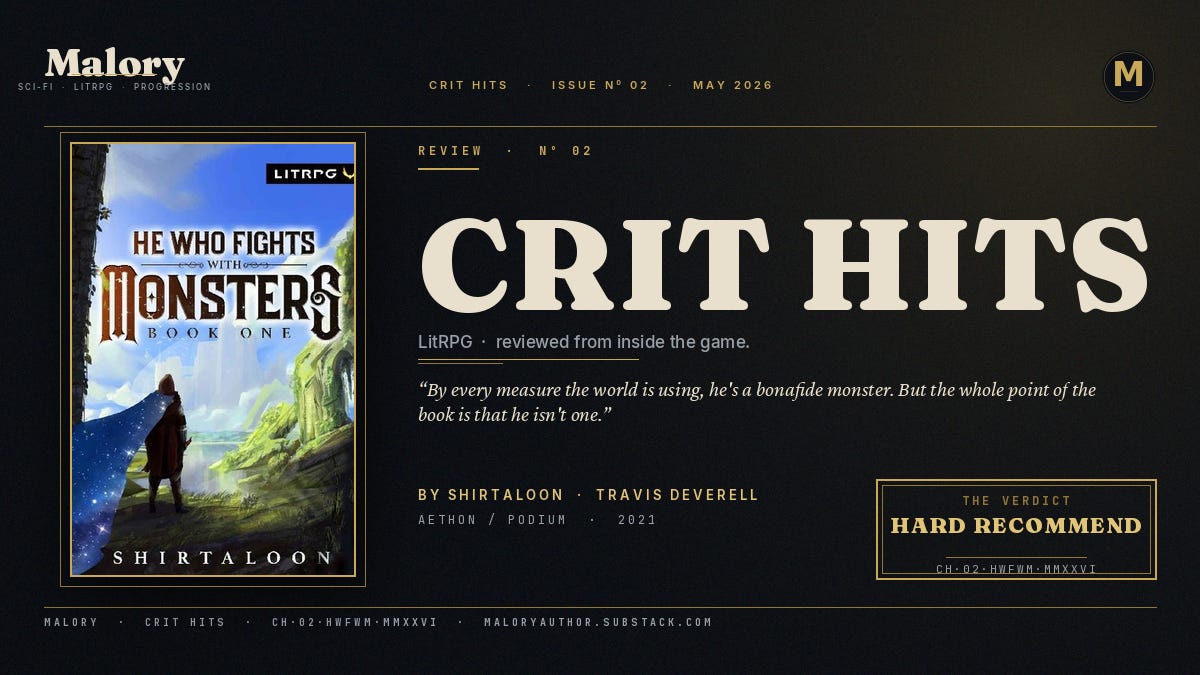
This is my second review of a LitRPG novel.
My first was about Primal Hunter, whose protagonist Jake Thayne is an introvert who barely speaks. This one is about a protagonist who can’t shut up.
He’s also… Australian.
He Who Fights with Monsters begins with Jason Asano face-down in a hedge maze, naked, bald, and with no memory of how he got there beyond playing video games and going to sleep in his own bed in Darth Vader boxer shorts.
So, two lines in, I think it’s fair to say that the book has more than shown its hand. The title is from Nietzsche, and is the bit about being careful when fighting monsters lest you become one yourself, and, I might be wrong, but I suspect Shirtaloon has put the Vader reference on page one as the subtlest of flags for what’s coming. The protagonist’s first internal monologue is comic. He runs a hand over his now-bald scalp and observes, “I thought it was meant to look bigger when you trimmed.”
Two pages later he’s killed a hamster the size of his head and looted it for ten spirit coins embossed with his own face giving a thumbs-up over the legend G’DAY MATE. By this point it is clear that the book is going to do serious work, but it’s also going to have a good time while doing so.
That balance between the two is where the best stuff lives.
Jason Asano is an office-supplies-store middle manager from Melbourne, son of a Japanese-by-conversion father and an Australian mother. In another way, though, he’s the latest entry in a hundred-and-fifty-year Australian literary tradition of irreverent-bloke-against-authority figures (Lawson’s swagmen, Paterson’s bushrangers and the Ned Kelly letters from gaol), and Shirtaloon is going to lean into all that lineage hard.
HAAAAAARRRRD.
By chapter four Jason has killed a man (a cultist who tried to eat him in a basement next to a pentagram, with a knife snatched from the cultist’s own hand), and he sits on the floor next to the body and rocks back and forth, and the book doesn’t move on for a whole paragraph. Weight like that on a first kill is rare in the genre. Most of the other books I’ll be covering seem to think a wisecrack covers the moment.
This book absolutely doesn’t.
And the magic system is where the real worldbuilding work shows up. There are four essences that people can install in their souls, and the fourth one forms automatically as a thematic confluence of the previous three. Jason ends up with blood, dark, doom, and sin (yeah, the Nietzsche thesis is not simply decorative). And the mechanism for how anyone advances is the novels’ fundamental class argument: aristocratic families buy monster cores from merchants and let their useless sons grind their way up to bronze rank without ever facing genuine danger, but that approach permanently caps their potential. On the other hand, anyone (poor people, mostly, because they can’t afford the alternative) can train, fight, meditate, and grow the hard way, which actually tends to work out better.
The book is honest about which of those is the rich kid’s option. “I bet it isn’t the danger that stops them,” Jason says, the moment it’s explained to him. “It’s the hard work, right?”
For me, it’s that moment that the general chat around this book mostly misses.
Jason is pretty well known in the LitRPG community for going on TED-talk-style morality rants about slavery and aristocracy and the concentration of power. And, to be clear, he really (really, really) does. However, he’s also, separately, a man who spends eight days curing diseases for free in eight villages on his way to the city, on the grounds that, since the gods are apparently real in this world, someone should be “waving the flag for secular morality.”
For me, Shirtaloon has his MC’s actions as the spine of the book and his speeches just as the noise which forms around them. An awful lot of readers, though, read all the noise and conclude that the protagonist is a smug, woke teenager. However, it’s always struck me that Jason’s actual behaviour across the novels - rather than what he says - powerfully argues for the opposite. Still, both readings are available. And whichever the reader takes from the book is the reader’s contribution, not the book’s failure.
Clearly, the standout relationship in Book 1 is Jason and his familiar: a sentient blood-drinking apocalypse leech that he names Colin. This appalling creature was generated through a ritual that requires Jason to bleed into a leech in the basin of an enemy family’s manor. And Colin’s from the apocalypse essence, which is the closest thing to evil-coded the universe has on offer. It’s enormous and toothed and Jason has a lot of fun talking to it. He even invents a hand-signals system for yes-and-no conversations and gets confused when the leech answers wrong. He carries it on his shoulder and when the priestess of Purity tries to kill it because it’s “obviously evil,” Jason’s response is to merge it back into his bloodstream for safekeeping and never trust the priestess again.
The whole title-thesis lives in that scene.
Jason has the dark essence, the blood essence, the doom essence, the sin essence, an apocalypse-leech familiar, and a body count that’s growing by the chapter. By every measure the world is using, he’s a bonafide monster.
But the whole point of the book is that he isn’t one.
And it does it awesomely.
Nevertheless, there’s plenty for those very much not here for this series to attack. For example, Jason certainly talks too much. And he gets the better of bronze-rank gods and silver-rank nobles in the same chatty style he uses on his sister. And the book bends itself to keep him alive through situations where he really shouldn’t. The romance is genre-typical and… not especially well handled. And there are filler chapters whose existence the book itself acknowledges with a knowing wink. Oh, and once Jason settles into the city of Greenstone and the indenture arc starts assembling, the supporting cast does what supporting casts often tend to do in the LitRPG genre, which is to exist merely to orbit the MC.
But none of that matters.
Because what Book 1 does have, though, and which LitRPGs rarely manage well, is proper, genuine and well-handled grief.
Late in Book 1 (light spoilers, sorry), an expedition goes wrong and a fairly important character dies, on screen, in combat against an enemy too far above their rank. Rufus (the team’s leader, who blames himself for everything always) goes blank-eyed for days. Jason organises the funeral ritual in the middle of the desert and starts crying as he draws the salt circle. And Gary, normally the comic-relief big man, takes Rufus into the desert and tells him to walk it off with friends.
Most of the closing arc of Book 1 is the three of them processing what happened. And, let me stress this, none of it is fixed by levelling up.
Almost no other LitRPG book is willing to let its grief stay grief. This one does, and it’s all the better for it.
I should add a word on the voice, which is heavily Australian. G’day mate, no worries, sod off, bugger that, the dashing good looks, the shonk. For readers from that register (Australia, New Zealand and from the parts of the UK with a similar deflationary instinct - which, full disclosure, I am), the voice will read as a man you’ve met before, and his irreverence will land as entirely recognisable rather than performed.
Obviously, though, for readers from outside that register, the same lines are likely to read as snark-by-design, and due to that Jason might feel quite wearing. This isn’t a bug. The book is, in part, an Australian deflecting a heroic-fantasy world with the language he grew up speaking, and the heroic-fantasy world pushes back. It’s a bit of a shame that whether the reader can hear that is largely a function of where the reader grew up. Which is probably why the standing phrase for the reader’s response to this book is: vegemite, don’t force it.
The audiobook deserves a paragraph. Actually, it deserves much more than one. Heath Miller (Australian, importantly) narrates the series and invents the voices for the entire multi-world cast on his own initiative, which on a series this dense in named characters is a genuine creative achievement. Unsurprisingly, the audio version of Book 1 was an Audible Best of 2021. And for many readers, it’s also the version where Jason reads as native rather than performed.
It’s an utter delight.
As my final note, this is a fantastic read, but it’s worth noting that the protagonist is going to irritate some readers. The book is also longer than it needs to be, but it’s also a book that takes the title’s Nietzsche reference seriously enough to put the Darth Vader boxers on page one and name the apocalypse-leech familiar Colin, and that’s something the genre doesn’t usually bother to do.
Read He Who Fights with Monsters if you are:
an Australian, a Kiwi, or a reader from the UK’s deflationary corners who has wanted a fantasy hero who sounds like the people you actually know
a reader who has wanted a power-fantasy MC who refuses to play polite with gods and aristocrats
a reader who has wanted their fantasy to take the moral weight of violence seriously and let grief stay grief
an audiobook listener who values a narrator doing serious creative work on a multi-world cast of named characters
Skip it if you are:
a reader who needs tight prose that’s been edited down from its serial origin
a reader who needs an MC who might actually fail
someone with zero patience for a protagonist who lectures, regardless of what his actions are doing
Hard Recommend.