

Mudie’s Did This to Us
Or: how a Bloomsbury library talked men out of fiction

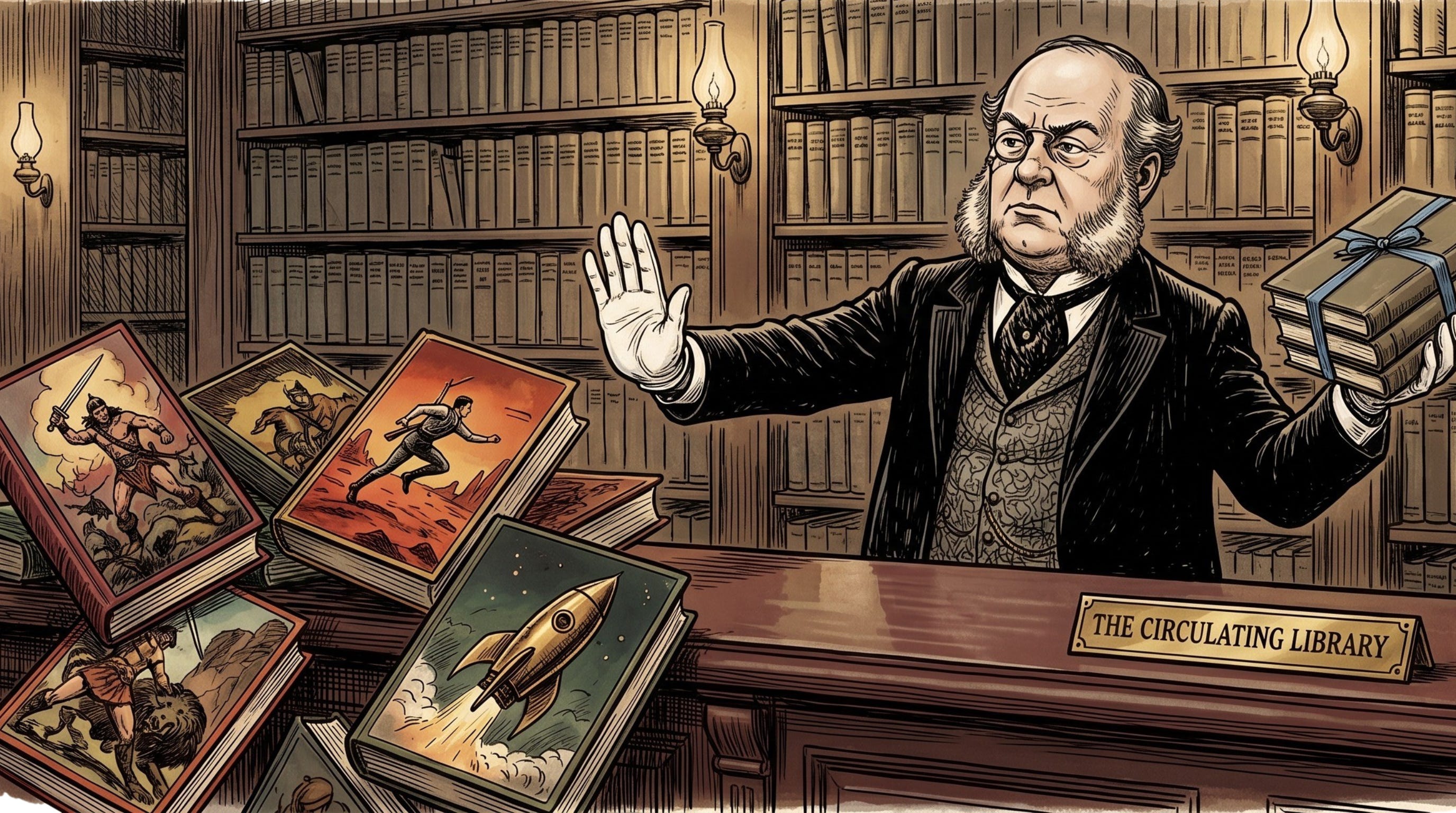
Every few weeks now a newspaper rediscovers that men have stopped reading.
The Wall Street Journal ran a version this year, with charts, and a sorrowful quote from a publisher, and somewhere around paragraph four the implication that this is new, and that the culprit is the phone, or the boy, or (the one everyone got excited about) the slow civilisational softening of a sex that used to build aqueducts and now can’t finish a book with too many long words.
But here’s the bit nobody at the Journal mentioned, because it would have ruined all their pretty charts. There was a time when fiction was a man’s vice. In fact, go back through history’s borrowing records and “men far outnumbered women” in the reading of novels. The reading of fiction never was a feminine pursuit men wandered away from. It was a masculine one men were, at a specific and datable moment, quietly escorted out of.
And the thing that did the escorting is still running. It’s just had a great many upgrades since.
The first version had a face and a name. Charles Edward Mudie opened his Bloomsbury library in 1842, and his business model was simple and boring in the way most culture-altering things are. For a guinea a year a subscriber got a steady drip of novels, dispatched as a “box of novels to thousands of country houses.”
By the 1890s Mudie’s was “as well-known a British institution as Big Ben.”
The thing to understand is that Mudie wrote nothing and published nothing. (Sound familiar at all?) He was a distributor, buying novels in bulk on a scale no rival could match, which meant his choices about what to stock were, in effect, choices about what got written. He was, basically, a content-recommendation algorithm with side-whiskers.
What Mudie stocked, the world read.
His was “a ‘select’ library, and he was the librarian who selected.” Select, of course, meaning clean, and Mudie’s view of clean had his own prejudices built in. George Meredith, whose novel fell foul of Mudie’s filter, left the period’s best one-line review: “I find I have offended Mudie... Because of the immoralities I depict! O canting Age!”
Mudie was franker about the nature of his service. His subscribers, he wrote, were “evidently willing to have a barrier of some kind between themselves and the lower floods of literature.” In his view, the customers wanted the barrier. They paid a guinea a year for a man to stand between them and the wrong books.
And the genius to it all was the low price. A new novel cost 31s. 6d. across three fat volumes, and that was a deliberately absurd amount. It “effectively discouraged several generations of English readers from buying novels, so much so that publishers long claimed that the English were not a book-buying people.”
Nobody bought and everybody rented, from Mudie, at a guinea a year. And here’s where the machine did its real work, because Mudie’s selections were, in their quietly administrative way, a machine for gendering fiction.
His subscribers were largely women, so Mudie stocked what he assumed they wanted. Geraldine Jewsbury, who did most of the actual reading for him, “strongly disapproved of stories in which business or the difficulties of a businessman figure.” Yep. The gatekeeper to the most important lending library in the Victorian world was screening out the male world on purpose. By the heart of the boom, of fifty-five novels in the library, thirty were by women and twenty-five by men. The supply had tilted so far that, in 1885, George Moore, locked out of the libraries for writing about sex like an adult, wrote that “the character for strength, virility, and purpose, which our literature has always held... is being gradually obliterated to suit the commercial views of a narrow-minded tradesman.”
By 1932 the gendering of fiction was running with nobody’s hand on it at all, and the cleverest critic of the age could survey the wreckage and miss that she was standing in it. Q. D. Leavis published Fiction and the Reading Public, one long horrified anthropology of what the masses had done to reading, which reads, at a squint, like a Letterboxd review written by God. The reading public, she reports, has a habit that “is now often a form of the drug habit... and women rather than men change the books (that is, determine the family reading).”
(By the way, here’s my favourite thing about Leavis. In her acknowledgements, she thanks one of the novelists who answered her questionnaire with particular generosity: Edgar Rice Burroughs. The high priestess of Scrutiny, the woman who taught two generations of dons to sneer at popular fiction, sat down and wrote fan mail to the man who invented Tarzan and sent John Carter to Mars. She knew exactly where the pulse was.)
And all of this didn’t end when Mudie’s closed in 1937. Rather, it got productised. Boots, the chemist, ran the Boots Book-lovers’ Library to 1966 and wrote the nature of book selection down into staff training: women were “inclined towards the domestic or personal type of detective stories, and men to the more realistic sort,” women “prefer tales of romance or about families to murder yarns.” Seventy percent of the customers were women.
What had taken Mudie a lifetime of personal prejudice was now something a teenager could learn on her first afternoon behind the till.
In every generation, somebody notices the smoke and never the fire. Coleridge, around 1817, blamed the “two public ordinaries of Literature, the circulating libraries, and the periodical press.” The 1860s blamed the “sensation novel.” 1885 blamed Moore’s tradesman. 1932 blamed Leavis’s drug habit. And 2026, I’m afraid, blames the bloody phone.
Every generation announces that the wrong people are reading the wrong things in the wrong way, and that this time, THIS TIME, it’s going to be terminal. Every generation is staring at the smoke and missing the machine.
The really good part is that the machine has a blind spot, and once, the men found it, they didn’t stage a reading strike. They were rescued, briefly, by exactly the books the filter existed to suppress: “the adventure stories of Haggard, Kipling, and Stevenson,” which “militated toward shorter length and the coincident greater thematic intensity.”
The thing that broke the gentle three-decker was the masculine adventure novel.
These books were horter, cheaper, stranger, heavy with strength and virility and purpose and a frankly unreasonable number of swords.
That lineage then went to the pulps, then the paperbacks, and it’s the direct ancestor of every Conan that Robert E. Howard hammered out at a penny a word, every dead sea-bottom Burroughs colonised with a Virginian gentleman, and every libertarian starship Heinlein ever launched. The genre fiction men actually read now, the stuff the Journal can’t count because it would never lower itself to review it, is the heir of the form that beat the machine the first time round.
The blind spot, it turns out, has massive swords.
Once upon a time, we had a culture of men who read fiction the way other men lifted weights, to get stronger, and we mislaid it. But we didn’t mislay it to TikTok. We lost the first and largest chunk of it to a Bloomsbury tradesman who decided, on commercial grounds and with a nervous eye on the family circle, that the strength and the virility and the purpose could go, because romance moved in volume and the family circle never complained.
So the next time a newspaper announces that men have stopped reading and gestures sadly at the phone, it’s worth remembering it has the right disaster and the wrong century. The man that did this had side-whiskers and a guinea-a-year subscription, and his approach has been upgraded ever since. It’s just that the latest version fits in a pocket and doesn’t need a man to run it at all.
Mudie did this to us.
The phone just turned up late, to take the photograph.
You are very right, but there's one name that deserves to be added to the list: William Dean Howells. He was editor of The Atlantic Monthly, and senior writer for harpers and a slew of others. He was THE tastemaker for American short fiction, and the chief reason that people like Henry James dominated the literary scene rather than us ever getting an American Kipling or another Edgar Allen Poe. He insisted that fantasy and adventure were dreck and that the only REAL fiction was realist social commentary.
This is why self-published fiction grew so fast, because it caters to markets big publishers stopped serving.